Permit Tracking Software: Keep Construction Stakeholders Informed
How contractors, developers, lenders, and owners monitor permit and inspection activity without manual portal checks
Dec 12, 2025
Dec 12, 2025


Construction projects rarely fail because teams don’t know how to build.
They fail because critical information arrives too late.
Permit approvals, inspection results, status changes, and expiration issues often determine whether a project moves forward—or stalls unexpectedly. Yet many construction teams still rely on a patchwork of municipal portals, spreadsheets, emails, and phone calls to keep track of this information.
That approach breaks down quickly once projects multiply, stakeholders expand, or jurisdictions vary.
This is where permit tracking software comes in—not as a replacement for the permitting process itself, but as a way to continuously monitor permit and inspection activity so project stakeholders can stay informed, coordinated, and proactive.
What Is Permit Tracking Software?
Permit tracking software is designed to monitor the status of building permits and inspections after they are filed, surfacing updates from building department systems in a centralized, easy-to-understand view.
At its core, it helps answer key questions such as:
Has a permit changed status?
Was an inspection scheduled, passed, or failed?
Has activity stalled?
Is a permit approaching expiration?
What changed since the last check?
Unlike permit preparation or submission tools, permit tracking software does not file applications or control outcomes. Its role is visibility—ensuring the right people see changes as they occur so they can respond appropriately.
Why Manual Permit Tracking Breaks Down
Most teams start with good intentions. One project might be manageable with a bookmarked city portal and a spreadsheet. But as soon as volume or complexity increases, the cracks appear.
Municipal Portals Aren’t Designed for Ongoing Monitoring
City and county systems are built for public access, not operational oversight. They often require:
Multiple logins across jurisdictions
Inconsistent layouts and terminology
Repeated checks to see if anything changed
Nothing alerts you when updates occur—you only find out if you happen to look at the right moment.
Spreadsheets Age Instantly
Spreadsheets reflect the moment they were last updated. In fast-moving construction environments, that information can become outdated within hours.
As projects scale, spreadsheets become:
Hard to maintain
Error-prone
Dependent on manual effort
This creates risk when decisions are based on stale permit or inspection status.
Information Lives in Too Many Places
Permit and inspection updates often pass through:
Municipal systems
Project managers
Permit runners
Subcontractors
Email threads
By the time an update reaches everyone who needs it, the opportunity to adjust schedules or prevent downtime may already be gone.
How Permit Tracking Software Changes the Equation
Instead of relying on manual checks, permit tracking software monitors for changes automatically.
Continuous Monitoring
The system regularly checks building department records for permit and inspection updates. When a change is detected—such as a new status, inspection result, or period of inactivity—it is surfaced clearly.
This shifts project stakeholders from reactive checking to proactive awareness.
Centralized Visibility
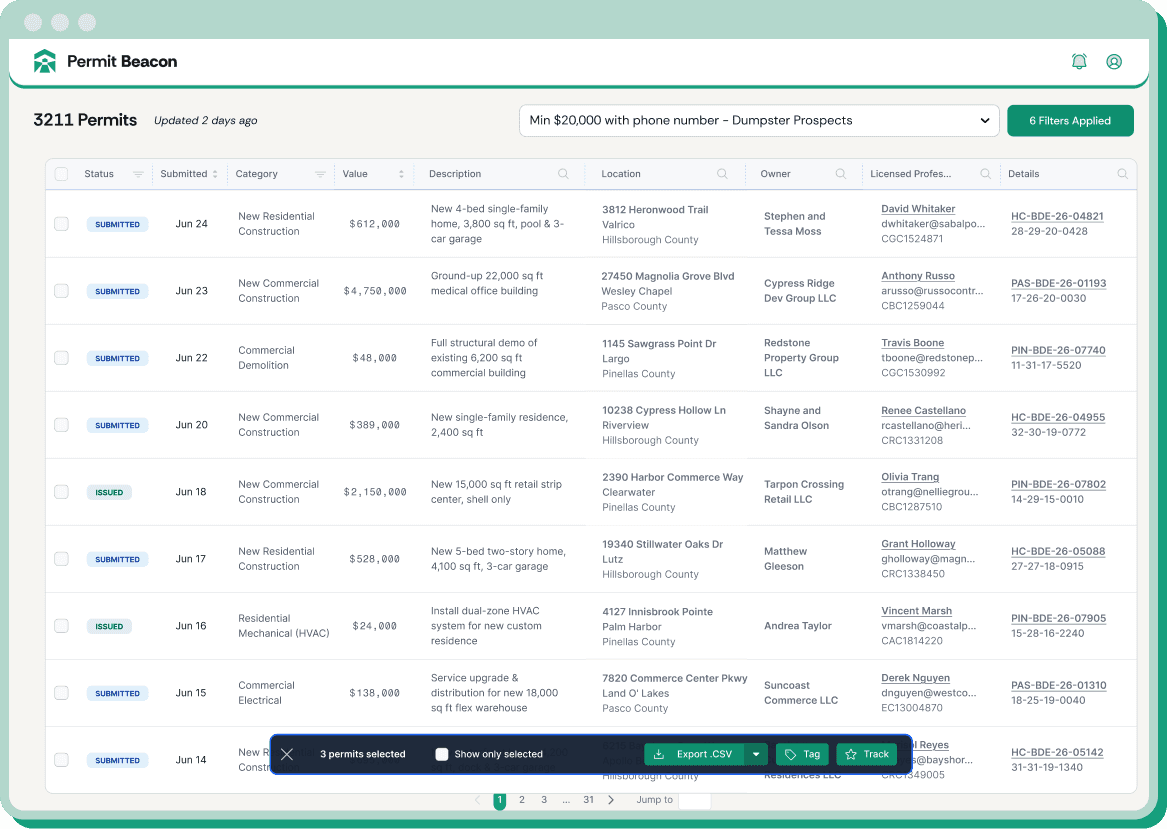
All permit and inspection status information is brought into a single dashboard. Teams no longer need to jump between portals, spreadsheets, and emails to understand what’s happening.
This is especially valuable when managing:
Multiple projects
Multiple jurisdictions
Multiple stakeholders
Clear Signals, Not Just Raw Data
Effective permit tracking software translates municipal updates into clear, understandable signals such as:
Approved
Pending
Scheduled
Passed
Failed
No recent activity
This makes the information useful for both technical and non-technical stakeholders.
Why Different Stakeholders Care About Permit Status
Permit tracking isn’t just a contractor problem. Permit and inspection status affects every stakeholder involved in a construction project, though each group uses the information differently.
Contractors & Builders
For contractors, permit and inspection updates directly impact:
Crew scheduling
Subcontractor coordination
Inspection readiness
Material deliveries
Missing or delayed updates can lead to idle crews and cascading delays.
Developers & Investors
Developers focus on overall project health. Permit and inspection activity often serves as an early indicator of:
Progress or stagnation
Bottlenecks
Contractor performance
Risk across a portfolio
Permit status tracking helps developers spot issues before they escalate.
Construction Lenders
Lenders rely on accurate verification of progress during underwriting and draw reviews. Manual updates are slow and inconsistent.
Permit and inspection monitoring helps lenders:
Verify activity more efficiently
Reduce reliance on second-hand updates
Maintain clearer documentation
Property Owners
Owners often lack direct visibility into permitting altogether and depend on contractors for updates.
Permit tracking software provides:
Plain-language status visibility
Greater transparency into inspections and approvals
Increased confidence that projects are moving forward
What to Look for in Permit Tracking Software
Not all tools that mention permits solve the same problem. When evaluating permit tracking software, focus on monitoring capability, not administrative workflows.
Automated Status Monitoring
The platform should continuously monitor permit and inspection status without requiring manual searches.
Inspection Status Visibility
Inspections are often the most time-sensitive milestone. Look for clear indicators of:
Scheduled inspections
Pass/fail outcomes
Follow-up activity
Multi-Project Dashboards
Permit tracking becomes far more valuable when managing more than one project. Strong dashboards allow teams to:
Scan project health quickly
Identify stalled activity
Drill down only when needed
Clear Change Detection
The most important question users ask is:
“What changed since the last time I looked?”
Good permit tracking software makes that obvious.
Stakeholder-Friendly Views
Different users need different levels of detail. The platform should present information in a way that’s accessible to field teams, executives, and external stakeholders alike.
Permit Tracking Is Becoming a Core Visibility Layer
As construction projects grow more complex, relying on manual permit tracking becomes increasingly risky.
Permit tracking software doesn’t guarantee approvals or control municipal processes—but it does ensure teams are working with current, reliable information.
For contractors, it reduces scheduling surprises.
For developers and investors, it improves oversight.
For lenders, it lowers risk.
For owners, it increases transparency.
In an industry where timing matters, knowing when something changes can make all the difference.
Interested in learning how automated permit monitoring works in practice?
Permit Beacon is built to help construction teams monitor permit and inspection status across projects and stakeholders—without adding unnecessary complexity.
Construction projects rarely fail because teams don’t know how to build.
They fail because critical information arrives too late.
Permit approvals, inspection results, status changes, and expiration issues often determine whether a project moves forward—or stalls unexpectedly. Yet many construction teams still rely on a patchwork of municipal portals, spreadsheets, emails, and phone calls to keep track of this information.
That approach breaks down quickly once projects multiply, stakeholders expand, or jurisdictions vary.
This is where permit tracking software comes in—not as a replacement for the permitting process itself, but as a way to continuously monitor permit and inspection activity so project stakeholders can stay informed, coordinated, and proactive.
What Is Permit Tracking Software?
Permit tracking software is designed to monitor the status of building permits and inspections after they are filed, surfacing updates from building department systems in a centralized, easy-to-understand view.
At its core, it helps answer key questions such as:
Has a permit changed status?
Was an inspection scheduled, passed, or failed?
Has activity stalled?
Is a permit approaching expiration?
What changed since the last check?
Unlike permit preparation or submission tools, permit tracking software does not file applications or control outcomes. Its role is visibility—ensuring the right people see changes as they occur so they can respond appropriately.
Why Manual Permit Tracking Breaks Down
Most teams start with good intentions. One project might be manageable with a bookmarked city portal and a spreadsheet. But as soon as volume or complexity increases, the cracks appear.
Municipal Portals Aren’t Designed for Ongoing Monitoring
City and county systems are built for public access, not operational oversight. They often require:
Multiple logins across jurisdictions
Inconsistent layouts and terminology
Repeated checks to see if anything changed
Nothing alerts you when updates occur—you only find out if you happen to look at the right moment.
Spreadsheets Age Instantly
Spreadsheets reflect the moment they were last updated. In fast-moving construction environments, that information can become outdated within hours.
As projects scale, spreadsheets become:
Hard to maintain
Error-prone
Dependent on manual effort
This creates risk when decisions are based on stale permit or inspection status.
Information Lives in Too Many Places
Permit and inspection updates often pass through:
Municipal systems
Project managers
Permit runners
Subcontractors
Email threads
By the time an update reaches everyone who needs it, the opportunity to adjust schedules or prevent downtime may already be gone.
How Permit Tracking Software Changes the Equation
Instead of relying on manual checks, permit tracking software monitors for changes automatically.
Continuous Monitoring
The system regularly checks building department records for permit and inspection updates. When a change is detected—such as a new status, inspection result, or period of inactivity—it is surfaced clearly.
This shifts project stakeholders from reactive checking to proactive awareness.
Centralized Visibility
All permit and inspection status information is brought into a single dashboard. Teams no longer need to jump between portals, spreadsheets, and emails to understand what’s happening.
This is especially valuable when managing:
Multiple projects
Multiple jurisdictions
Multiple stakeholders
Clear Signals, Not Just Raw Data
Effective permit tracking software translates municipal updates into clear, understandable signals such as:
Approved
Pending
Scheduled
Passed
Failed
No recent activity
This makes the information useful for both technical and non-technical stakeholders.
Why Different Stakeholders Care About Permit Status
Permit tracking isn’t just a contractor problem. Permit and inspection status affects every stakeholder involved in a construction project, though each group uses the information differently.
Contractors & Builders
For contractors, permit and inspection updates directly impact:
Crew scheduling
Subcontractor coordination
Inspection readiness
Material deliveries
Missing or delayed updates can lead to idle crews and cascading delays.
Developers & Investors
Developers focus on overall project health. Permit and inspection activity often serves as an early indicator of:
Progress or stagnation
Bottlenecks
Contractor performance
Risk across a portfolio
Permit status tracking helps developers spot issues before they escalate.
Construction Lenders
Lenders rely on accurate verification of progress during underwriting and draw reviews. Manual updates are slow and inconsistent.
Permit and inspection monitoring helps lenders:
Verify activity more efficiently
Reduce reliance on second-hand updates
Maintain clearer documentation
Property Owners
Owners often lack direct visibility into permitting altogether and depend on contractors for updates.
Permit tracking software provides:
Plain-language status visibility
Greater transparency into inspections and approvals
Increased confidence that projects are moving forward
What to Look for in Permit Tracking Software
Not all tools that mention permits solve the same problem. When evaluating permit tracking software, focus on monitoring capability, not administrative workflows.
Automated Status Monitoring
The platform should continuously monitor permit and inspection status without requiring manual searches.
Inspection Status Visibility
Inspections are often the most time-sensitive milestone. Look for clear indicators of:
Scheduled inspections
Pass/fail outcomes
Follow-up activity
Multi-Project Dashboards
Permit tracking becomes far more valuable when managing more than one project. Strong dashboards allow teams to:
Scan project health quickly
Identify stalled activity
Drill down only when needed
Clear Change Detection
The most important question users ask is:
“What changed since the last time I looked?”
Good permit tracking software makes that obvious.
Stakeholder-Friendly Views
Different users need different levels of detail. The platform should present information in a way that’s accessible to field teams, executives, and external stakeholders alike.
Permit Tracking Is Becoming a Core Visibility Layer
As construction projects grow more complex, relying on manual permit tracking becomes increasingly risky.
Permit tracking software doesn’t guarantee approvals or control municipal processes—but it does ensure teams are working with current, reliable information.
For contractors, it reduces scheduling surprises.
For developers and investors, it improves oversight.
For lenders, it lowers risk.
For owners, it increases transparency.
In an industry where timing matters, knowing when something changes can make all the difference.
Interested in learning how automated permit monitoring works in practice?
Permit Beacon is built to help construction teams monitor permit and inspection status across projects and stakeholders—without adding unnecessary complexity.
Construction projects rarely fail because teams don’t know how to build.
They fail because critical information arrives too late.
Permit approvals, inspection results, status changes, and expiration issues often determine whether a project moves forward—or stalls unexpectedly. Yet many construction teams still rely on a patchwork of municipal portals, spreadsheets, emails, and phone calls to keep track of this information.
That approach breaks down quickly once projects multiply, stakeholders expand, or jurisdictions vary.
This is where permit tracking software comes in—not as a replacement for the permitting process itself, but as a way to continuously monitor permit and inspection activity so project stakeholders can stay informed, coordinated, and proactive.
What Is Permit Tracking Software?
Permit tracking software is designed to monitor the status of building permits and inspections after they are filed, surfacing updates from building department systems in a centralized, easy-to-understand view.
At its core, it helps answer key questions such as:
Has a permit changed status?
Was an inspection scheduled, passed, or failed?
Has activity stalled?
Is a permit approaching expiration?
What changed since the last check?
Unlike permit preparation or submission tools, permit tracking software does not file applications or control outcomes. Its role is visibility—ensuring the right people see changes as they occur so they can respond appropriately.
Why Manual Permit Tracking Breaks Down
Most teams start with good intentions. One project might be manageable with a bookmarked city portal and a spreadsheet. But as soon as volume or complexity increases, the cracks appear.
Municipal Portals Aren’t Designed for Ongoing Monitoring
City and county systems are built for public access, not operational oversight. They often require:
Multiple logins across jurisdictions
Inconsistent layouts and terminology
Repeated checks to see if anything changed
Nothing alerts you when updates occur—you only find out if you happen to look at the right moment.
Spreadsheets Age Instantly
Spreadsheets reflect the moment they were last updated. In fast-moving construction environments, that information can become outdated within hours.
As projects scale, spreadsheets become:
Hard to maintain
Error-prone
Dependent on manual effort
This creates risk when decisions are based on stale permit or inspection status.
Information Lives in Too Many Places
Permit and inspection updates often pass through:
Municipal systems
Project managers
Permit runners
Subcontractors
Email threads
By the time an update reaches everyone who needs it, the opportunity to adjust schedules or prevent downtime may already be gone.
How Permit Tracking Software Changes the Equation
Instead of relying on manual checks, permit tracking software monitors for changes automatically.
Continuous Monitoring
The system regularly checks building department records for permit and inspection updates. When a change is detected—such as a new status, inspection result, or period of inactivity—it is surfaced clearly.
This shifts project stakeholders from reactive checking to proactive awareness.
Centralized Visibility
All permit and inspection status information is brought into a single dashboard. Teams no longer need to jump between portals, spreadsheets, and emails to understand what’s happening.
This is especially valuable when managing:
Multiple projects
Multiple jurisdictions
Multiple stakeholders
Clear Signals, Not Just Raw Data
Effective permit tracking software translates municipal updates into clear, understandable signals such as:
Approved
Pending
Scheduled
Passed
Failed
No recent activity
This makes the information useful for both technical and non-technical stakeholders.
Why Different Stakeholders Care About Permit Status
Permit tracking isn’t just a contractor problem. Permit and inspection status affects every stakeholder involved in a construction project, though each group uses the information differently.
Contractors & Builders
For contractors, permit and inspection updates directly impact:
Crew scheduling
Subcontractor coordination
Inspection readiness
Material deliveries
Missing or delayed updates can lead to idle crews and cascading delays.
Developers & Investors
Developers focus on overall project health. Permit and inspection activity often serves as an early indicator of:
Progress or stagnation
Bottlenecks
Contractor performance
Risk across a portfolio
Permit status tracking helps developers spot issues before they escalate.
Construction Lenders
Lenders rely on accurate verification of progress during underwriting and draw reviews. Manual updates are slow and inconsistent.
Permit and inspection monitoring helps lenders:
Verify activity more efficiently
Reduce reliance on second-hand updates
Maintain clearer documentation
Property Owners
Owners often lack direct visibility into permitting altogether and depend on contractors for updates.
Permit tracking software provides:
Plain-language status visibility
Greater transparency into inspections and approvals
Increased confidence that projects are moving forward
What to Look for in Permit Tracking Software
Not all tools that mention permits solve the same problem. When evaluating permit tracking software, focus on monitoring capability, not administrative workflows.
Automated Status Monitoring
The platform should continuously monitor permit and inspection status without requiring manual searches.
Inspection Status Visibility
Inspections are often the most time-sensitive milestone. Look for clear indicators of:
Scheduled inspections
Pass/fail outcomes
Follow-up activity
Multi-Project Dashboards
Permit tracking becomes far more valuable when managing more than one project. Strong dashboards allow teams to:
Scan project health quickly
Identify stalled activity
Drill down only when needed
Clear Change Detection
The most important question users ask is:
“What changed since the last time I looked?”
Good permit tracking software makes that obvious.
Stakeholder-Friendly Views
Different users need different levels of detail. The platform should present information in a way that’s accessible to field teams, executives, and external stakeholders alike.
Permit Tracking Is Becoming a Core Visibility Layer
As construction projects grow more complex, relying on manual permit tracking becomes increasingly risky.
Permit tracking software doesn’t guarantee approvals or control municipal processes—but it does ensure teams are working with current, reliable information.
For contractors, it reduces scheduling surprises.
For developers and investors, it improves oversight.
For lenders, it lowers risk.
For owners, it increases transparency.
In an industry where timing matters, knowing when something changes can make all the difference.
Interested in learning how automated permit monitoring works in practice?
Permit Beacon is built to help construction teams monitor permit and inspection status across projects and stakeholders—without adding unnecessary complexity.
Important disclaimer:
The information provided on this blog is for general informational purposes only and should not be construed as legal or financial advice. While we strive to provide accurate and reliable information, we cannot guarantee the accuracy or completeness of the content. Readers should consult with a professional before making any decisions based on the information contained herein.

Safeguard Your Construction Projects
Be among the first to experience Permit Beacon. Sign up for early access and secure your extended free trial today!


Safeguard Your Construction Projects
Be among the first to experience Permit Beacon. Sign up for early access and secure your extended free trial today!


Safeguard Your Construction Projects
Be among the first to experience Permit Beacon. Sign up for early access and secure your extended free trial today!