6 min read
Building permits mark the moment a project becomes real — and the window when vendor decisions are still being made.
For subcontractors, suppliers, and site service vendors, winning new work is rarely about finding projects. It’s about finding them at the right moment.
By the time a project becomes visible through site activity, signage, or word of mouth, many of the early procurement decisions have already been made. Trade contractors are selected. Materials are ordered. The first vendors are locked in.
Building permit data sits earlier in that timeline. A permit filing is one of the clearest public signals that a project is moving from planning toward active construction — and it provides early visibility into new construction projects at the moment procurement decisions are being made.
The Permit Filing as a Transition Point
A construction project doesn’t begin when crews show up on site. By the time a permit is filed, much of the pre-construction work is already complete: land acquisition, architectural plans, engineering and approvals, financing and entitlements. The project is real, the general contractor is engaged, and the timeline is defined.
What follows permit submission and approval happens quickly, but not all at once. Many trade decisions are made during plan review, before a permit is issued. By the time approval comes through, a significant portion of trade work may already be awarded.
Permit issuance more directly signals site mobilization. Within weeks of approval, the lot is cleared, temporary fencing goes up, dumpsters are delivered, portable toilets are set up, and crews begin arriving. This is when site service vendors are typically selected and work on site begins to take shape.
That stretch — from permit submission through site mobilization — is where procurement decisions take shape. Different vendors engage at different points within that window, but all benefit from earlier visibility into when it begins.
Why Timing Matters More Than Discovery
Most vendors don’t struggle to find projects. They struggle to find them early enough to compete.
By the time a project is visible through traditional channels, initial vendor decisions may already be made, work may already be underway, and remaining opportunities are more competitive. Permit data shifts that timing. Instead of discovering projects after they surface, vendors can identify them at the moment they become actionable.
This matters across a range of vendor types — trade subcontractors bidding trade work, suppliers fulfilling materials with long lead times, and site service providers procured around the start of construction. In each case, decisions cluster at specific points in the permit lifecycle, which is what makes permit data informative.
Where Permit Data Fits Among Lead Sources
Most vendors already use a mix of channels to generate construction leads — referrals, word of mouth, site visibility, and bid platforms or plan rooms. Each has value, but each has limits.
Referrals and word of mouth depend on existing relationships, which means coverage is uneven and hard to scale into new geographies. Site visibility — noticing activity while driving past a job — only surfaces a project once construction is already underway. Bid platforms and plan rooms tend to capture larger, formally bid projects, which leaves much of the smaller-builder and custom GC market outside their scope.
The common thread is that these channels are inconsistent and not systematic. They surface projects when they happen to surface, and often later in the lifecycle than vendors would prefer.
Permit data is different in kind. It’s a public, structured record of project activity that becomes available as projects become actionable — earlier in the procurement timeline than most other channels can reach. It doesn’t replace existing lead sources, but it fills a visibility gap they don’t address.
Permit Submission vs. Permit Issuance
Permit data carries two distinct signals, and which one matters most depends on what a vendor sells.
Permit submission is the earlier signal. When a builder files for a permit, the project has reached real commitment — plans are drawn, financing is in place, the GC is engaged. For trade subcontractors, this is often the procurement window itself: trade work gets bid and awarded during plan review, before the permit is issued. By the time approval comes through, many trades are already selected.
This is most relevant for trades and suppliers where procurement happens during planning and coordination — including framing, insulation, foundation, and other work where the builder is still finalizing partners. In these cases, submission isn’t just an early heads-up. It’s often the point where outreach and bidding decisions are happening.
Permit issuance is the later, sharper signal for services procured around the start of construction. Approval is closely tied to site mobilization, which is when decisions get made for dumpster rental, portable toilets, temporary fencing, and site preparation. For these vendors, issuance is when the procurement window opens.
Both signals reflect active procurement. They just serve different vendors at different points in the project lifecycle.
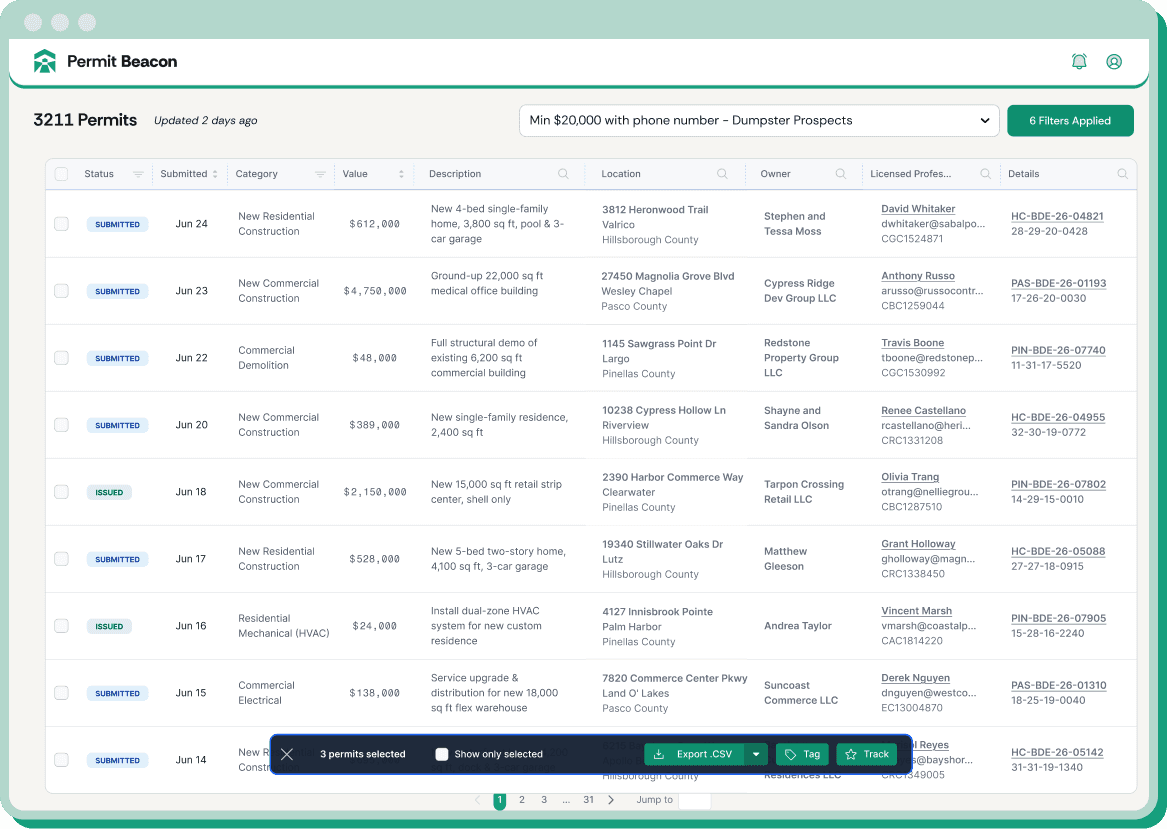
Permit Beacon surfaces both events in a single feed, with filtering between submitted and issued permits, so vendors see new submissions as they’re filed and get notified again when a previously submitted permit becomes issued. The result is a continuous view of where each project sits in its lifecycle.
Not All Permits Represent Real Opportunities
An important distinction is the type of builder behind the permit.
Large production builders typically operate with pre-established vendor relationships across their pipeline. By the time they file a permit, vendors are already assigned. Reaching out adds little value because the decision has already been made elsewhere.
Smaller builders and custom general contractors often operate differently. Vendor decisions are made project by project, procurement happens closer to job start, and builders are more accessible and actively sourcing.
This is why filtering matters. Raw permit volume is high, but the subset where active procurement is actually happening is much smaller. Permit Beacon includes a filter to exclude large production builders specifically, which removes the bulk of the noise and leaves the permits where active procurement is more likely.
How Vendors Use Permit Data
For vendors who use permit data effectively, the process is straightforward:
Monitor newly submitted and newly issued permits in target jurisdictions
Filter for relevant permit types, project value ranges, and builder types
Review available project details and listed contacts — typically the general contractor or the project contact named on the permit
Reach out while procurement decisions are still being made
The work isn’t complicated. What makes it effective is consistency and timing — engaging the right contact during the window when vendors are actually being chosen, rather than after.
Why Manual Permit Tracking Breaks Down
Permit data is publicly available, but accessing it consistently is difficult.
Each jurisdiction maintains its own portal, with its own structure and search behavior. Vendors who try to track permits manually end up navigating dozens of separate systems, often dedicating staff hours to checking county and municipal sites for new filings. Without a consistent process, new permits are easily missed or discovered too late to act on.
The result is a familiar pattern: valuable data exists in public records, but the operational cost of monitoring it manually means most vendors don’t use it effectively.
From Searching to Signal
Continuous monitoring changes the underlying process. Instead of checking portals one by one, vendors work from a consolidated view of permit activity across the jurisdictions they care about — delivered as email alerts as new submissions and issuances appear.
The differentiation isn’t in access to permit data. It’s in how that data becomes a usable signal. A few capabilities matter:
Consolidation across jurisdictions. Permit activity in any meaningful market is spread across many municipal and county systems. Permit Beacon pulls these into a single feed, with jurisdiction filters so vendors can focus on the markets they actually serve.
Both signals, in one view. Submissions and issuances are surfaced together, with filtering between them, so vendors can work from whichever signal matters for their business — or both.
Filtering for relevance. Filters for permit type (new residential, new commercial, solar, demolition, pool, and others), declared permit value range, and exclusion of large production builders turn raw permit volume into a working set of new construction projects worth pursuing.
The shift is from manual searching — where coverage is uneven and timing is accidental — to a consistent, filtered signal of activity that vendors can actually act on.
For a broader overview, see our guide to permit tracker fundamentals.
For more on why manual tracking breaks down at scale, see why manual permit tracking doesn’t scale.
Permit Filing as an Early Signal
A building permit is more than a record of approval. It marks the moment a project transitions from planning to execution — when a contractor is mobilizing, a timeline is defined, and procurement decisions are being made.
For vendors, that signal is what creates the timing advantage. It’s an early indicator of new construction opportunities — surfacing projects before they become widely known, while procurement is still open and competition is lower.
Why Timing Determines Who Wins the Work
Lead generation in construction is ultimately a timing problem. The projects exist; the question is whether vendors hear about them while decisions are still being made or after the fact.
Permit data closes that gap. It provides earlier visibility into new construction projects as they become actionable, and it does so systematically — across jurisdictions, on a consistent cadence, with filtering that separates real opportunities from noise.
The advantage isn’t just awareness. It’s positioning — being in front of the right project, at the right contact, during the window when vendors are actually being chosen. That’s what permit data, used well, makes possible.
Important disclaimer:
The information provided on this blog is for general informational purposes only and should not be construed as legal or financial advice. While we strive to provide accurate and reliable information, we cannot guarantee the accuracy or completeness of the content. Readers should consult with a professional before making any decisions based on the information contained herein.